VV-XI
This model spans two distinct cabinet designs, each with its own rarity and value rating:
- Tabletop Version (1910-1912): Rarity ** Value ***
- Floor Model (1912-1921): Rarity * Value *
What do rarity and value ratings mean?
The VV-XI or "Victrola the Eleventh" was Victor's top-selling machine of all time. Introduced in 1910 as a premium tabletop model, it soon transitioned into a fully enclosed floor phonograph that became Victor's #1 product during its 11-year production run. More than 850,000 VV-XI phonographs were produced between 1910 and 1921, outselling all other models by a wide margin. There were two distinct variations of the VV-XI model; they will be split into major chronological groupings. A detailed breakdown of serial number vs. year produced can be found at the bottom of the page.
Iteration One: Tabletop Model (1910-1912)
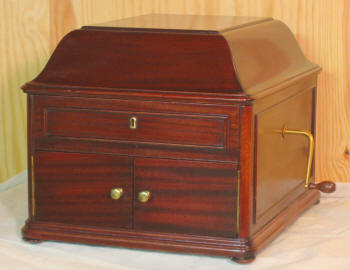 The
VV-XI phonograph was introduced during the autumn of 1910, and was then considered to
be a premium tabletop model at a time when Victor's product lineup was
beginning to mature. The unsuccessful VV-XII was Victor's
first attempt at producing a tabletop internal-horn phonograph; however the horn
opening was far too small and the machine was deemed to be too expensive. The
company learned this lesson, and subsequently introduced the new VV-XI the
following year. Priced at $100.00 (which equates to about $3,500.00 in today's
money), it was $25.00 cheaper than the XII and offered far better performance.
Like the XII, the VV-XI featured gold-plated hardware and a nicely crafted
cabinet with added trim, but the motor was downsized to a two-spring design. The
much larger horn opening provided vastly improved sound volume over the anemic
XII, which was a big advantage. The XI could be purchased in mahogany, or in a
variety of oak finishes.
The XI was launched during a transition period when 'talking machines' were dropping in price and
becoming affordable for the average buyer. In the spring of 1911, the
brand-new VV-IX tabletop model was introduced by Victor at
a list price of only $50.00, and except for the omission of the gold-plated
hardware and some cabinet trim, the new IX used the same mechanical components
as the twice-as-expensive VV-XI. This logically drew many buyers away from
the tabletop XI, and it was discontinued in the spring
of 1912. At that time the XI series was transitioned to a fully enclosed floor
model.
Later versions of this design iteration will have an "A" or "B" suffix after the serial number to
indicate minor design changes to mechanical components.
While VV-XI phonographs are extremely common, these early-generation designs
will garner considerably more collector interest than the later versions. Based on the serial numbers of
surviving examples, approximately 10,000 of these machines were made.
The
VV-XI phonograph was introduced during the autumn of 1910, and was then considered to
be a premium tabletop model at a time when Victor's product lineup was
beginning to mature. The unsuccessful VV-XII was Victor's
first attempt at producing a tabletop internal-horn phonograph; however the horn
opening was far too small and the machine was deemed to be too expensive. The
company learned this lesson, and subsequently introduced the new VV-XI the
following year. Priced at $100.00 (which equates to about $3,500.00 in today's
money), it was $25.00 cheaper than the XII and offered far better performance.
Like the XII, the VV-XI featured gold-plated hardware and a nicely crafted
cabinet with added trim, but the motor was downsized to a two-spring design. The
much larger horn opening provided vastly improved sound volume over the anemic
XII, which was a big advantage. The XI could be purchased in mahogany, or in a
variety of oak finishes.
The XI was launched during a transition period when 'talking machines' were dropping in price and
becoming affordable for the average buyer. In the spring of 1911, the
brand-new VV-IX tabletop model was introduced by Victor at
a list price of only $50.00, and except for the omission of the gold-plated
hardware and some cabinet trim, the new IX used the same mechanical components
as the twice-as-expensive VV-XI. This logically drew many buyers away from
the tabletop XI, and it was discontinued in the spring
of 1912. At that time the XI series was transitioned to a fully enclosed floor
model.
Later versions of this design iteration will have an "A" or "B" suffix after the serial number to
indicate minor design changes to mechanical components.
While VV-XI phonographs are extremely common, these early-generation designs
will garner considerably more collector interest than the later versions. Based on the serial numbers of
surviving examples, approximately 10,000 of these machines were made.
Iteration Two: Enclosed floor cabinet (1912-1921)
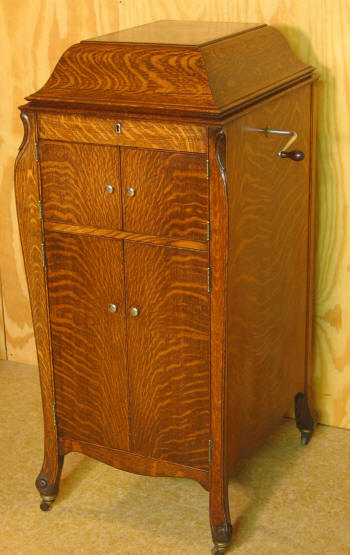
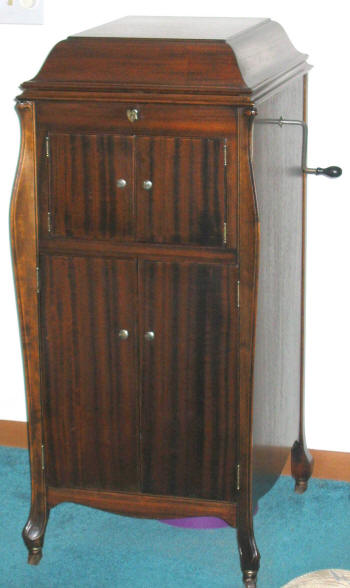
The VV-XI was transitioned into a floor model in the spring of 1912, which immediately became a 'hit' with the buying public. With substantial size, quality workmanship and an affordable price, the XI soon represented one of the best values in the talking machine business. Over 10,000 were sold by the end of the first year, and production quickly ramped-up to a peak of nearly 200,000 units annually by 1920. With plenty of secure space to store records and a nicely designed cabinet with machined trim, it brought the phonograph into many middle-class homes of the era. Buyers could order the XI in two shades of mahogany (red or brown), or in a wide variety of oak finishes. Walnut became available as a no-cost option in 1919. The VV-XI used a powerful two-spring motor and nickel-plated hardware, making it a great value. Due to inflation, prices gradually inched-upwards from the 1912 introduction price of $100.00, eventually reaching $150.00 by 1920. While this was still a considerable sum of money, the VV-XI was certainly well within reach of many American families at that time. Earlier versions (left) have 'crescent moon' shapes machined into the corner posts; later versions (right) feature a larger cabinet and simple 'scroll top' corner posts. Floor-model VV-XI Victrolas will have an "C", "D", "E", "F" or "G" suffix letter after the serial number, indicating small upgrades to the motor and/or mechanical components. Later machines may have an "A" suffix after the model number (see chart below). A total of 843,000 copies of this variation were produced until it was discontinued from production in 1920, and replaced by the new VV-100 the following year. However, it is likely that a considerable quantity of XI machines remained unsold at that time, and that dealers continued to stock/sell leftover VV-XI models well into 1921. Due to the large volume that were originally produced, these floor model versions of the VV-XI (and many similar Victrola models) are typically ignored by collectors today, unless in exceptional original condition. Far too many were produced to be considered 'collectible' in the current market.
| Manufacture Date | Approximate Serial Number Range | Feature Notes |
|---|---|---|
| 1910 | 501-2000 | Tabletop model with bullet brake, round speed control. |
| 1911 | 2000-6800 | A suffix introduced late in year |
| 1912 | 6800-22000 | Late tabletop models have an A suffix. Transition to floor model in March (at s/n 10675). The earliest floor models have a B suffix. Vertical record storage slats are used, (rather than horizontal shelves). |
| 1913 | 22000-66000 | Auto brake added early in year. B, C and D suffices used during year. |
| 1914 | 66000-117000 | D, E, F or G suffix used during year. F suffix models begin use of horizontal record shelves in place of vertical slats. |
| 1915 | 117000-200000 | G suffix |
| 1916 | 200000-312000 | G suffix |
| 1917 | 312000-430000 | Small glass speed indicator introduced at s/n 377950. Suffix letters after serial number and "Crescent moon" cabinet corner carvings eliminated at s/n 378000. XI-A* designation and use of "fat" tone arm begun late in year at approx. S/N 400000. |
| 1918 | 430000-498000 | XI-A* designation used |
| 1919 | 498000-620000 | XI-A* designation ended early in year at approx. S/N 534000. |
| 1920 | 620000-855000 | Finished cabinet back starting at s/n 779500 |
* The "A" designation after the model number indicates that an improved motor design. This design continued to be used for the remainder of production, although the "A" was dropped in 1919.
The survival database currently shows the earliest existent VV-XI to be S/N 508 and the latest to be S/N 873426. Please note that large blocks of serial numbers were likely skipped in production; therefore the total number produced and the highest serial number will not be exactly correlated for this model!
Do you own a Victrola VV-XI? Please take a moment and enter some basic information about your machine into the collector's database by clicking here. No personal information is required.