VV-IX
 The
VV-IX or Victrola the Ninth, was a very
popular phonograph; it was the company's top-selling tabletop model with a closable lid.
The concept of a 'tabletop' Victrola started with the failed VV-XII model in 1909. They had
the right idea for this type of small Victrola, but the horn opening was too
small and the machine was too expensive. Subsequent tabletop models launched
in 1910 included the VV-X and VV-XI, which had much better performance, but
were still expensive for the average household. So in the summer of 1911, the
VV-IX and VV-VIII models were introduced to appeal to buyers with modest
budgets. The IX was priced at $50.00 (equivalent to $1,750.00 today).
It featured a larger cabinet than the VV-VIII
model, and also offered the choice of a mahogany or oak veneer finish. Its
introduction was concurrent with the launch of a wide lineup of newly-designed machines. The IX featured a well-crafted cabinet, nickel
plated hardware, a two-spring motor, and Victor's Exhibition Soundbox. Along
with nearly all of the other newly-introduced models, sales of the VV-IX were
strong from the start. Production of the IX ran for more than 13 years, which
was certainly a tribute to its success. It became Victor's fourth best-selling
model of all time.
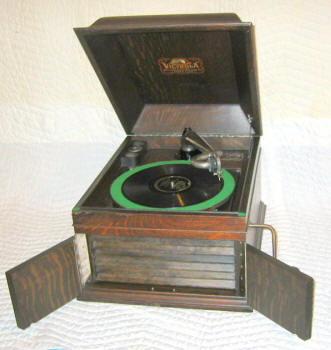
The earliest VV-IX machines (top left) used simple wood baffles to direct the
sound internally from the tonearm base to the downward-facing 'slats' at the
front opening; closable 'tone doors'
were used to control the sound volume. A full-size 12" turntable was used. It was not until 1913 that an actual horn
assembly (consisting of a cast iron elbow and wood horn mouth) was used
internally to improve the sound volume. At the same time, the cabinet was
enlarged slightly.
The
VV-IX or Victrola the Ninth, was a very
popular phonograph; it was the company's top-selling tabletop model with a closable lid.
The concept of a 'tabletop' Victrola started with the failed VV-XII model in 1909. They had
the right idea for this type of small Victrola, but the horn opening was too
small and the machine was too expensive. Subsequent tabletop models launched
in 1910 included the VV-X and VV-XI, which had much better performance, but
were still expensive for the average household. So in the summer of 1911, the
VV-IX and VV-VIII models were introduced to appeal to buyers with modest
budgets. The IX was priced at $50.00 (equivalent to $1,750.00 today).
It featured a larger cabinet than the VV-VIII
model, and also offered the choice of a mahogany or oak veneer finish. Its
introduction was concurrent with the launch of a wide lineup of newly-designed machines. The IX featured a well-crafted cabinet, nickel
plated hardware, a two-spring motor, and Victor's Exhibition Soundbox. Along
with nearly all of the other newly-introduced models, sales of the VV-IX were
strong from the start. Production of the IX ran for more than 13 years, which
was certainly a tribute to its success. It became Victor's fourth best-selling
model of all time.
The earliest VV-IX machines (top left) used simple wood baffles to direct the
sound internally from the tonearm base to the downward-facing 'slats' at the
front opening; closable 'tone doors'
were used to control the sound volume. A full-size 12" turntable was used. It was not until 1913 that an actual horn
assembly (consisting of a cast iron elbow and wood horn mouth) was used
internally to improve the sound volume. At the same time, the cabinet was
enlarged slightly. 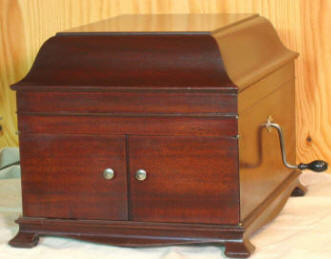 In early 1915, small 'feet' were added to the cabinet
(bottom left). While many of the IX model's design features
evolved over the years (see breakdown below), it remained about the same in form
and function as when it was when first introduced.
Incremental suffix letters following the serial number indicate
small upgrades to the motor and/or mechanical
components.
Per factory documentation, a total of just over
569,000 Victrola IX models were produced. Production of the IX was likely terminated in the spring of 1924.
As with many other Victrola models, the VV-IX was a huge success for the
company; but when sales of Victrolas began to slow in favor of radio, Victor
failed to respond to the market changes by slowing their production rate.
Therefore, in spite of lagging sales, many thousands of these machines continued
to come off the assembly line, and the large network of dealers and distributors
began bursting at the seams with unsold Victrolas. Due to this considerable
overproduction, it is likely that many late-production VV-IX
models were shipped to markets in Latin America, or were sold during the company's
'half-price' sale during the summer of 1925.
For more information on Victor's financial crisis of 1924-1925 and the
overproduction of phonographs, please click
here.
In early 1915, small 'feet' were added to the cabinet
(bottom left). While many of the IX model's design features
evolved over the years (see breakdown below), it remained about the same in form
and function as when it was when first introduced.
Incremental suffix letters following the serial number indicate
small upgrades to the motor and/or mechanical
components.
Per factory documentation, a total of just over
569,000 Victrola IX models were produced. Production of the IX was likely terminated in the spring of 1924.
As with many other Victrola models, the VV-IX was a huge success for the
company; but when sales of Victrolas began to slow in favor of radio, Victor
failed to respond to the market changes by slowing their production rate.
Therefore, in spite of lagging sales, many thousands of these machines continued
to come off the assembly line, and the large network of dealers and distributors
began bursting at the seams with unsold Victrolas. Due to this considerable
overproduction, it is likely that many late-production VV-IX
models were shipped to markets in Latin America, or were sold during the company's
'half-price' sale during the summer of 1925.
For more information on Victor's financial crisis of 1924-1925 and the
overproduction of phonographs, please click
here.
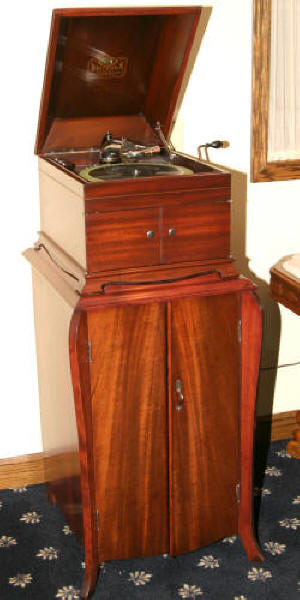 Several suppliers produced custom base cabinets for the VV-IX (right). Many of these cabinets merged into the base of the phonograph so
perfectly,
that the combination of phonograph and base appears as one floor-standing
machine. These cabinets were made by a variety of companies, including the
Pooley Furniture Company of Philadelphia. While Victor never produced a base
cabinet for this model, they were frequently sold as aftermarket accessories by
Victor dealers.
Due to the large volume that were originally produced, the VV-IX (and many
similar low-cost Victrola models) are typically ignored by collectors
today, unless in exceptional original condition. Far too many were produced to be considered 'collectible'
in the current market.
Several suppliers produced custom base cabinets for the VV-IX (right). Many of these cabinets merged into the base of the phonograph so
perfectly,
that the combination of phonograph and base appears as one floor-standing
machine. These cabinets were made by a variety of companies, including the
Pooley Furniture Company of Philadelphia. While Victor never produced a base
cabinet for this model, they were frequently sold as aftermarket accessories by
Victor dealers.
Due to the large volume that were originally produced, the VV-IX (and many
similar low-cost Victrola models) are typically ignored by collectors
today, unless in exceptional original condition. Far too many were produced to be considered 'collectible'
in the current market.
| VV-IX Manufacture Date | Approximate Serial Number Range | Feature Notes |
|---|---|---|
| 1911 | 501-15000 | First machines use bullet brake. Bullet brake ends at S/N 6394. Late year machines use an A suffix |
| 1912 | 15000-47000 | Some machines have an A or B suffix |
| 1913 | 47000-87500 | Some machines have a B, C or D suffix |
| 1914 | 87500-149000 | Some machines have a D, E or F suffix. |
| 1915 | 149000-214000 | Early year machines have an F suffix, most year's production has G suffix. Feet added very early in year around S/N 149000 on G suffix machines. Some machines begin using a dash mark after the model identification |
| 1916 | 214000-286500 | Most machines have a G suffix |
| 1917 | 286500-357500 | Some machines have no suffix letter, others continue the G suffix. Small glass speed control introduced at S/N 316350. IX-A* designation used after September 1917 |
| 1918 | 357500-401500 | IX-A designation ceases after December 1918. |
| 1919 | 401500-461000 | Suffix letters permanently discontinued. Some machines between S/N 409000 and 421000 have a leading "zero" prior to the serial number. This was due to a stamping error on some plates, wherein duplicate serial numbers were issued. The leading zero likely allowed production auditing during this period. |
| 1920 | 461000-529500 | |
| 1921 | 529500-535000 | No. 2 Soundbox added |
| 1922 | 535000-545000 | |
| 1923 | 544000-555000 | |
| 1924 | 550000-558000 | Some machines use orange turntable felt cover |
* Note: the "A" designator after the model indicates a revised motor design. The A was soon dropped from the dataplate, but the improved motor remained.
The survival database currently shows the earliest existent VV-IX to be S/N 581 and the latest to be S/N 566246.
Do you own a Victrola VV-IX? Please take a moment and enter some basic information about your machine into the collector's database by clicking here. No personal information is required.