Evaluating a Restored Machine
In my estimation, there are only three '"condition grades" for restored machines:
- RESTORED CONDITION ONE: A machine which has been restored (or partially restored) to professional standards (closely replicating the original factory appearance) and is in excellent condition, showing no wear or very minimal usage. The finish must be near perfect, and all components retain the correct original appearance. This is typically classified as RESTORED-EXCELLENT. In most cases, the value of the machine will be slightly less than an excellent original, but will still retain much of its collectability and future worth.
- RESTORED CONDITION TWO: A correctly restored machine which shows minor signs of wear due to age or usage. This is classified as RESTORED-GOOD. The value will be considerably less than a good original machine.
- RESTORED CONDITION THREE: An incorrectly restored machine or a well-restored machine showing considerable wear or damage. This is classified as RESTORED-POOR (no matter how nice it may appear). The value will always be significantly reduced from an original machine in good or fair condition. We do not sell machines in this category.
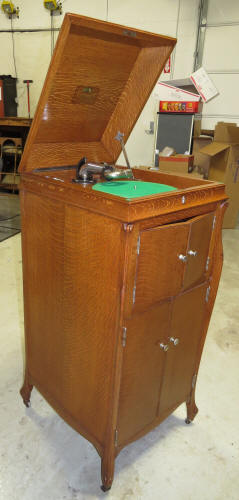
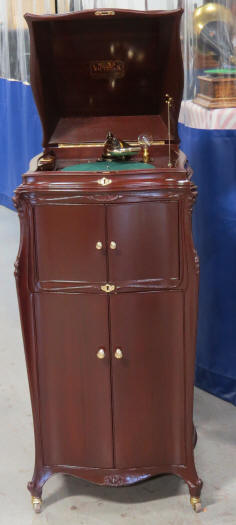
The VV-XIV, shown at the left, has been correctly restored using the proper stain, shellac sealer and varnish top-coat, and would be considered to be "RESTORED EXCELLENT". It very closely approaches the appearance it had when new, and there is absolutely no damage from extended use. Note that the finish color and sheen is the same throughout, and it does not have an overly mirror-like appearance. The VV-XVII on the right is incorrectly restored, and would be considered "RESTORED-POOR". It looks great at first glance. But notice that the cabinet finish has a 'milky' appearance, and that the reflection and color under the lid is far different than the rest of the cabinet. This implies that the stain-matching process was not carefully executed, and that a polyurethane finish (or too many heavy coats of lacquer) were applied. The gold is overly glossy and bright (Victor used a 'muted' gold plating process, wherein the gold alloy was mixed with a small amount of copper). It sure looks nice, but try to get any money for it from an experienced collector!! The cost of re-restoration would exceed the value when complete, so this machine would likely be delegated to the 'parts donor' category. Or it could be sold at a low price as a nice conversation piece for an old house. Nothing wrong with that! But it is not for a serious collector. Why is there no "RESTORED-FAIR" classification? Because the vast majority of collectors (with the money to buy what they want) are looking for exceptional and correct machines. A phonograph which underwent an excellent and authentic restoration back in 1980, and has since been knocked-around or subjected to damage will require re-restoring, just as would be the case for a poorly restored phonograph. Therefore the valuation for a correctly restored machine which is no longer in good condition would be comparable to the value of a machine which has been incorrectly restored. They both will require a complete 're-do'. So there is no need for additional categories of restored phonographs. Restored machines are commonly graded as either "RESTORED EXCELLENT", "RESTORED GOOD" or "RESTORED POOR". No further evaluation is required.