Authentic or Fake?
 Victor, Victrola,
Electrola and Orthophonic, are the brand names for phonographs made
by the Victor Talking Machine of Camden, New Jersey. Victor was an independent
company from 1901-1929, and was
not affiliated with RCA. The RCA Corporation bought Victor in late 1929,
and they continued to use the Victor and Victrola names and logos on their products for
many years after the purchase (e.g. "RCA Victor"). Thus, you can find "RCA
Victor" or "Victrola" products that were made by RCA
(or later by other companies using the original trademark) all the way up to today.
Victor, Victrola,
Electrola and Orthophonic, are the brand names for phonographs made
by the Victor Talking Machine of Camden, New Jersey. Victor was an independent
company from 1901-1929, and was
not affiliated with RCA. The RCA Corporation bought Victor in late 1929,
and they continued to use the Victor and Victrola names and logos on their products for
many years after the purchase (e.g. "RCA Victor"). Thus, you can find "RCA
Victor" or "Victrola" products that were made by RCA
(or later by other companies using the original trademark) all the way up to today.
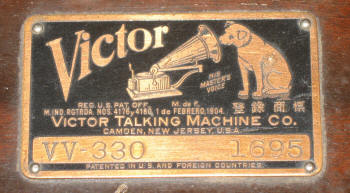
All Victor products are clearly marked in several places with the words "Victor Talking Machine Company" (not RCA) identification and the dog/phonograph logo. If you can't find these identifiers somewhere on your phonograph, or if it says "RCA" somewhere, it is not a Victor Talking Machine product! There is usually a metal dataplate near the turntable (or under it) which has model and serial number information. If you can't find this identification, it is likely that you have either a non-Victor antique phonograph, or a modern fake. Antique phonographs made by Edison, Columbia or other makers may certainly be valuable, but are not covered on this website. RCA-branded phonographs may be of historical interest, but were made after 1929, and typically bring less money than the earlier Victor machines.
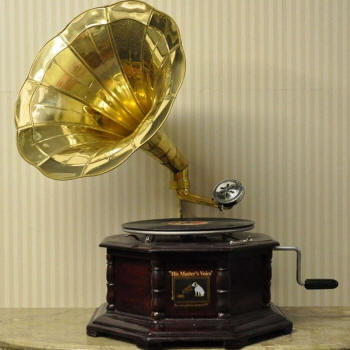
Forgeries of external horn phonographs (e.g. Victors) are rampant on eBay, at some antique stores and flea markets. These can usually be spotted a mile away by any serious collector; the horns are often made of stamped tin and plated in a cheap-looking brass or gold, and the upward angle of the horn is usually abrupt and too high. There is often a pattern or design embossed in the horn. A sharp rough angle at the horn "elbow" (the area at the base of the horn) is a dead-giveaway. Victor's elbows were formed with a gradual (smooth) rounded transition, not a sharp, sudden corner.
 Most fakes are made in
India or China, some using all-new parts and others with a mish-mash of old and new parts. Before a novice buyer purchases
an external horn phonograph, an expert should be consulted to provide an
assessment of the machine in question, as there are many good-looking fakes on the market
today. Some
of the reproductions can look pretty impressive (picture on left); others
are artificially "aged" to look old and can be quite convincing. When the
builder uses components (e.g. cabinets and/or horns) from an actual antique
phonograph, and assembles them using newer motors and hardware parts, it can
be difficult for the non-expert buyer to determine authenticity.
Reproduction or "fake antique" machines have a nominal value of about
$100.00 at resale today, mostly as decorations or movie props. In fact, the vast majority of movies you watch today will use these fakes when an antique phonograph is called for. In most
cases, repair services and motor rebuilders won't touch them, as the parts
are often impossible to find, and are often "jury-rigged" together to make
the motor functional. So if it quits working, you are probably out of luck.
Most fakes are made in
India or China, some using all-new parts and others with a mish-mash of old and new parts. Before a novice buyer purchases
an external horn phonograph, an expert should be consulted to provide an
assessment of the machine in question, as there are many good-looking fakes on the market
today. Some
of the reproductions can look pretty impressive (picture on left); others
are artificially "aged" to look old and can be quite convincing. When the
builder uses components (e.g. cabinets and/or horns) from an actual antique
phonograph, and assembles them using newer motors and hardware parts, it can
be difficult for the non-expert buyer to determine authenticity.
Reproduction or "fake antique" machines have a nominal value of about
$100.00 at resale today, mostly as decorations or movie props. In fact, the vast majority of movies you watch today will use these fakes when an antique phonograph is called for. In most
cases, repair services and motor rebuilders won't touch them, as the parts
are often impossible to find, and are often "jury-rigged" together to make
the motor functional. So if it quits working, you are probably out of luck.
There are some highly-skilled craftsmen who are now producing exceptional reproductions of rare external-horn machines, including authentic-looking wood horns and base cabinets. These are quite expensive to purchase new from the sellers, but the prices are not nearly as high as purchasing a true original example. We have seen some of these phonographs at shows, and the attention to detail and finish-work is nothing short of incredible. Even the hardware and dataplates are perfect. In a few years, after these reproductions have "worn-in" a bit, it may become increasingly difficult to discern them from originals.
There are not many fake Victrolas (internal horn phonographs) currently on the market, primarily because they are not generally as valuable as earlier external-horn Victor machines. Recently, we have seen a few misrepresented Victrolas on eBay and elsewhere. The most common forgery is to attach a dataplate from a rare model (or to use a reproduction dataplate) to make the phonograph appear more valuable than it is. We have also seen swapped or reproduction Victor dataplates attached to phonographs that are bastardized combinations of components from who-knows-where. These fakes are easily identified by any knowledgeable collector.
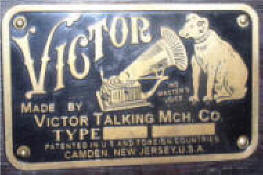
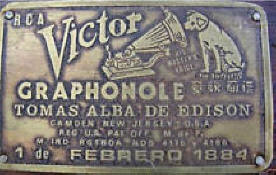
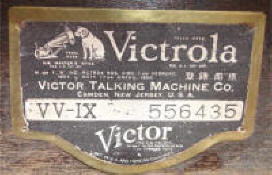
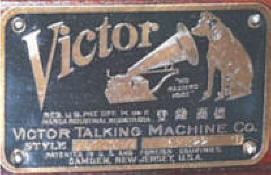
Nipper on Steroids: There are many different styles of reproduction dataplates, which are often placed on fake machines. Fakes do not have high-quality graphics. From left to right: 1) the dog on this Chinese-made reproduction plate has apparently been undergoing illegal steroid treatments causing his muscles to bulge and his head to shrink. 2) A reproduction plate from Mexico made by someone who has been sampling too much tequila. Both Victor and Edison brands are represented on this plate, along with the meaningless term "Graphonole" and a random 1884 date. RCA is also mentioned just to make it more confusing. Makes absolutely no sense. 3) a "cut-out" plate from a legitimate 1920's Victrola model that was modified and mounted on a fake external horn machine to make it appear authentic. 4) The real thing. Victor had very high quality control when these plates were made, and never produced poorly designed or cheaply struck examples. While there are several different versions of authentic plates, the quality of the trademark's logo and "Victor" wording were always excellent; however, the stamped model number and serial number information could get a bit sloppy at times.
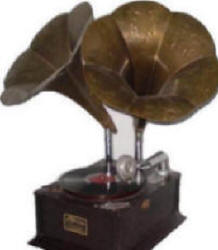
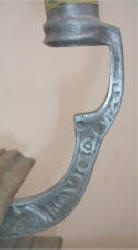
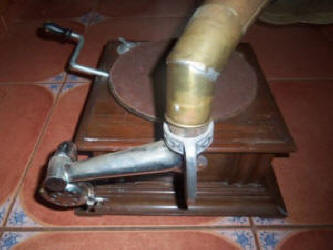
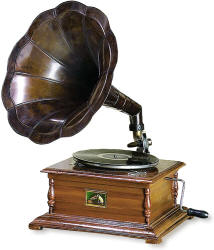
Low Quality and Goofy-Looking Designs are a Sure Indication of a Fake: From left to right: 1) Victor never made "dual" horn models, and a correct Victor metal horn was never embossed with designs. Legitimate horns never point this sharply upward. 2) The crude and uneven quality of this cast backbracket holding the horn is a dead giveaway of a cheap reproduction machine (never mind that "RCA Victor" appears in weak lettering on a phonograph supposedly made years before the RCA Corporation even existed). 3) This monstrosity is a poster-child for cheap reproductions. Poorly soldered joints, a soundbox "dangling" from the tonearm without a support, the crank in the wrong location sticking out awkwardly at an angle from under the turntable, and a cheap pine case. Note that the angle of the horn elbows on these fakes are very sharp and abrupt. Victor always produced elbows with smoothly rounded corners. 4) It might look nice, but it is a reproduction. A dark-stained pine cabinet, crooked-sitting soundbox, and crude details point to a modern reproduction. Again, the angle of the horn elbow is very sharp. Buyer beware!