Original or Restored?
This is a challenging topic. We define the term "Restoration" as the process of modifying or replacing the original finish and/or cosmetics of a phonograph. This could include stripping the original finish and applying new finish materials, or simply using solvents or softeners to wipe-down the original finish in order to smooth-out or remove blemishes. It could also include the use of 'overspray' materials which cover the original factory finish to increase the 'gloss'. Such restoration work may involve the entire machine, or only portions of the cabinet. In all these examples, the original finish has been modified, and this constitutes a "Restoration" or "Partial Restoration" by most collectors. In most cases, restored machines will bring less money than good original machines, even though they may look much nicer. This is unlike the automobile collecting community, wherein high quality restorations often sell for more than original cars. "Restoration" does NOT include making necessary repairs to the mechanical components. Mechanical work to assure correct functionality should never give cause to classify a phonograph as 'restored' as long as the repairs are made correctly, using original-type replacement parts. In most instances, making repairs on spring-wound phonograph motors or other components is not a costly endeavor. An exception would be for 1920's machines with electronic amplification and/or radios. Repairs to these electronic systems can become quite costly; however once complete, the appraised value would increase correspondingly.
 Most Victors
and Victrolas made between 1901 and 1924 used a varnish-over-shellac finish,
but there are many exceptions to this rule. Some oak finishes have a shellac
finish with a protective wax applied; others may have been fumed via an
ammonia bath and will have no finish coats. Those machines with a
varnished finish were certainly smooth and glossy, but never to the extent one
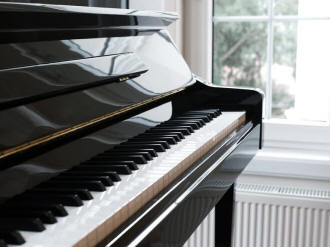
would find on a lacquered, mirror-finish piano today (as
seen at right). Victrolas produced after 1925 featured
a semi-gloss lacquer finish, which has a very muted appearance with
only slight reflectivity. Bear in mind that the vast majority of
Victor products were mass-produced. While there were a few special-order models
with fine hand-crafted finishes, over 98% of Victor's phonographs came down
the assembly line quickly, were dumped in a stain tank and then
either brushed or sprayed by hand with finish coats. Then a quick polish and
out the door it went. Victor's quality control was excellent; it is
extremely rare to find an original machine with drips or runs, or showing
signs of dust or contamination in the finish. So while Victor's products always
featured an excellent appearance, they must be considered as production-line
products and will usually not replicate the craftsmanship one would find in
expensive world-class furniture. In order to determine true
condition, the machine must be subjectively evaluated against how it appeared
when new. It is therefore imperative that the potential buyer understand the
degree of glossiness and surface texture which were found on the different
finishes when the phonograph was produced. There is often some degree of
overlap in shading and finish texture in each finish type due to nominal
variations of the veneers which were used, but for example, the buyer
should expect Victor's "GOP" (Golden Oak Polished) finish to be much more
reflective/glossy than the "GOW" (Golden Oak Waxed) finish. To further complicate matters, there
can also be considerable overlap
between some of Victor's more expensive finishes such as American Walnut and
Circassian Walnut; some Victrolas will exhibit grain figuring and staining
characteristics that are common to both varieties. This can cause confusion
and disagreement in the pricing. A complete discussion of the
types of finishes appears here,
and readers are encouraged to review this subject before proceeding further.
Most Victors
and Victrolas made between 1901 and 1924 used a varnish-over-shellac finish,
but there are many exceptions to this rule. Some oak finishes have a shellac
finish with a protective wax applied; others may have been fumed via an
ammonia bath and will have no finish coats. Those machines with a
varnished finish were certainly smooth and glossy, but never to the extent one
would find on a lacquered, mirror-finish piano today (as
seen at right). Victrolas produced after 1925 featured
a semi-gloss lacquer finish, which has a very muted appearance with
only slight reflectivity. Bear in mind that the vast majority of
Victor products were mass-produced. While there were a few special-order models
with fine hand-crafted finishes, over 98% of Victor's phonographs came down
the assembly line quickly, were dumped in a stain tank and then
either brushed or sprayed by hand with finish coats. Then a quick polish and
out the door it went. Victor's quality control was excellent; it is
extremely rare to find an original machine with drips or runs, or showing
signs of dust or contamination in the finish. So while Victor's products always
featured an excellent appearance, they must be considered as production-line
products and will usually not replicate the craftsmanship one would find in
expensive world-class furniture. In order to determine true
condition, the machine must be subjectively evaluated against how it appeared
when new. It is therefore imperative that the potential buyer understand the
degree of glossiness and surface texture which were found on the different
finishes when the phonograph was produced. There is often some degree of
overlap in shading and finish texture in each finish type due to nominal
variations of the veneers which were used, but for example, the buyer
should expect Victor's "GOP" (Golden Oak Polished) finish to be much more
reflective/glossy than the "GOW" (Golden Oak Waxed) finish. To further complicate matters, there
can also be considerable overlap
between some of Victor's more expensive finishes such as American Walnut and
Circassian Walnut; some Victrolas will exhibit grain figuring and staining
characteristics that are common to both varieties. This can cause confusion
and disagreement in the pricing. A complete discussion of the
types of finishes appears here,
and readers are encouraged to review this subject before proceeding further.
The first step in evaluating any antique is to determine if it has been restored or if it retains its original finish. As stated above, a phonograph which has been restored will typically be worth less than an identical phonograph which retains its good original finish, even if the original finish shows some signs of wear. This topic will be discussed in detail in the "State of the Market" section. There are only two types of restorations: correct and incorrect. There is no such thing as an 'almost correct' restoration when evaluating a phonograph. A machine which has been restored, even by the most proficient experts, will usually exhibit a few clues of restoration, which will become apparent to an experienced collector; however these signs can be easily overlooked by the average buyer. It may be necessary to remove cabinet components to inspect hidden areas for evidence of rework or newly applied finish materials. For exceptionally well-executed restorations, a "UV" lamp may be used to search for evidence of recent rework. This type of inspection goes beyond the scope of this discussion. We have noted several instances where the restoration work was so well executed that it became very difficult to determine if the machine was a mint-original or a world-class restoration. One major collector recently purchased a beautiful "mint-original" machine at auction, only to find that it had been exceptionally well restored when later inspected in direct sunlight. The only clues were some tiny overspray "specks" under the motorboard and inside the cabinet which would not have appeared on an original factory finish. It was a superb restoration; however the buyer was still disappointed that he had not purchased an original machine. However, these situations are quite unusual. In most cases, it is very easy to determine if a machine has been restored. A well-restored machine will still hold value, especially if it is a rare model. Perhaps the original finish was too far gone to be presentable. Perhaps the owner wanted it 'sparkling new'. Nothing wrong with that, just as long as the buyer knows it was restored.
Unfortunately, the vast majority of 'restored' machines one will find for sale on Ebay or at the local auction house have been restored incorrectly. Some of them terribly. Some readers will find a Victrola in their attic, and claim that "Aunt Tilly bought it brand new and it has never been touched". After a brief evaluation, it is very apparent that 'Uncle Fred' must have restored it in his basement many years ago; that type amateur restoration is virtually always incorrect. The valuation will consequently be a big disappointment. So what constitutes a correct restoration? It is the process of replicating (to the extent possible) the original appearance of the entire phonograph, right down to matching the wood color (shading), the use of proper grain fillers, and achieving the correct degree of glossiness. This requires a significant effort in copying the finishing processes and materials that were used when the machine was originally manufactured. An authentic restoration is extremely time-consuming and can be very costly. Mastering the process of properly preparing and stripping the finish, repairing damage, using the proper types of stain to match the original, correctly applying authentic base sealers and finish coats, and attention to details such as accurately replating the hardware is not a trivial task. The staff at "Joe's Furniture Restoration" service will certainly not have this skillset. Stripping off the old finish via washing-down the cabinet in a tank, using a low-cost commercial stain and slapping on a coat of polyurethane may be great for an old kitchen table, but will not result in an authentic restoration for an antique phonograph. Unless the restorer locates the proper finishing materials and has experience in the application methods, it is highly unlikely that the end-result will be considered 'correct' in the eyes of a serious collector. Modern finishing materials that one may find at ACE Hardware or Home Depot usually have some form of "poly" or "thane" in their names (e.g. polyurethane, urethane, varathane, etc.) which implies a plastic-based substance is present in the material. This is done to reduce VOC's, meaning that the products are not as dangerous or polluting as were earlier generations of finishing materials. Plasticized finish products will not provide the same appearance as did the original varnishes or shellacs that were used when the machines were new. So, given the difficulties in finding authentic finishing materials today (they are still available from limited sources), and developing the necessary skills to apply them correctly, it follows that not many restorers will be capable of executing an accurate restoration. Don't get me wrong...there are some outstanding restoration services out there. But they are few and far between. And bear in mind that a restored machine may have a beautiful and stunning appearance, and yet be completely ruined from a collector's standpoint because the restoration is incorrect. This is the single most common problem we find today, and will severely decrease the appraised value of a phonograph. A detailed summary of a proper restoration process can be found here. Remember the four cardinal rules:
1) A MACHINE CAN ONLY BE ORIGINAL ONCE
2) ONCE A PHONOGRAPH HAS BEEN RESTORED, IT CAN'T BE "UN-RESTORED". YOU CAN ONLY STRIP IT BACK DOWN AND TRY TO DO IT RIGHT.
3) KNOWLEDGABLE COLLECTORS WILL ALMOST ALWAYS PAY MORE FOR A GOOD ORIGINAL MACHINE OVER A WELL-RESTORED MACHINE
4) THE MARKET VALUE FOR ANY MACHINE WITH AN AMATEUR (OR MEDIOCRE PROFESSIONAL) RESTORATION WILL BE MINIMIZED, NO MATTER HOW NICE IT LOOKS
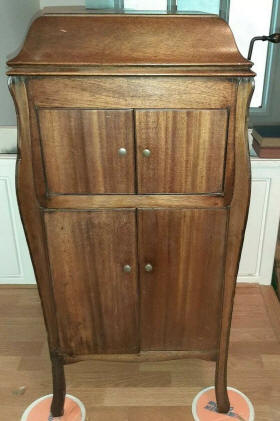
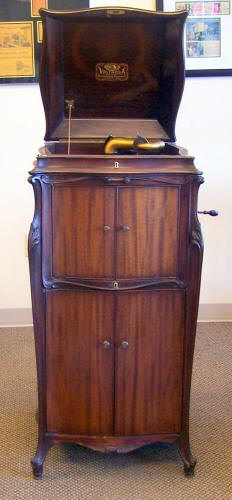 So how do we determine a 'correct restoration'? Let's start with a basic
example; the relatively rare and
low-production VV-125 shown at left. It has a very
impressive appearance, and shows beautiful wood grain; has no runs or drips
in the finish, and the Victrola works well. But it is a terrible
restoration. This machine was originally produced with a very glossy dark
red-brown stain (as seen under the lid) with the same high-luster surface
finish on all surfaces, inside and out. After the restoration it has a 'two-tone' appearance, with the front doors not matching the
rest of the cabinet.
So how do we determine a 'correct restoration'? Let's start with a basic
example; the relatively rare and
low-production VV-125 shown at left. It has a very
impressive appearance, and shows beautiful wood grain; has no runs or drips
in the finish, and the Victrola works well. But it is a terrible
restoration. This machine was originally produced with a very glossy dark
red-brown stain (as seen under the lid) with the same high-luster surface
finish on all surfaces, inside and out. After the restoration it has a 'two-tone' appearance, with the front doors not matching the
rest of the cabinet.
 It has been
refinished improperly, and is considered to be an "incorrect restoration".
The valuation will suffer significantly.
So why would somebody
perform this type of restoration on a rare machine? There are many reasons.
It might have been in rough condition and looked too tired to put in the
living room. Or perhaps someone just wanted a 'jazzy' looking antique. Maybe
it was restored 60 years ago, at a time when these old phonographs were
considered to be worthless. Most likely, the restorer had no idea how to
replicate the original colors and finish, and probably didn't care at the
time. As an example, my uncle 'restored' virtually all the hand-me-down
antiques that he brought home from my grandparent's house, and much of his work consisted of
applying bright stain colors
and polyurethane finish coats. The furniture looked nice at the time, but it
is essentially ruined from a collector's standpoint; it will be very
difficult to get any serious money for something that has been improperly
restored. If a Victrola is poorly restored in that manner, the dedicated
collector (who has the cash to spend on rare phonographs) will have to re-restore it in order
to make it acceptable in a high-end collection. And that can be a REALLY
expensive proposition. Better to wait and purchase an
excellent original example.
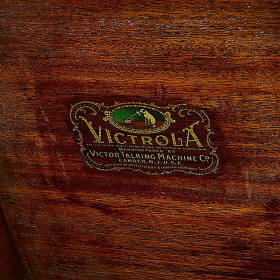
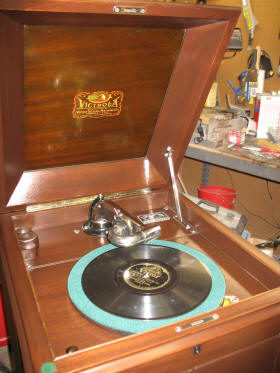
The brown mahogany Victrola VV-XVI (picture top right) also has clear signs of an "incorrect restoration". Note that the shading
on the flat panel under the lid (where the decal is located) is darker
and slightly glossier than the surrounding sections; this is also seen when compared to the motorboard and exterior. To
the new collector, that type of difference
could be attributed to
prolonged exposure to heat in an attic, where the interior areas are
better protected than the outside of the cabinet. Exterior fading and
crazing occurs frequently on many original
machines, as seen on the original VV-IX (picture below right). But in the case of the
restored XVI, wouldn't the motorboard (the area around the turntable) also have
been preserved and still retain the original darker underlid color and gloss? Why are
the protected areas different in shading? And if the cabinet had
faded due to exposure, the exterior should be a bit rough and
crazed, or show damage from being knocked-around in an attic for 100 years?
It has been
refinished improperly, and is considered to be an "incorrect restoration".
The valuation will suffer significantly.
So why would somebody
perform this type of restoration on a rare machine? There are many reasons.
It might have been in rough condition and looked too tired to put in the
living room. Or perhaps someone just wanted a 'jazzy' looking antique. Maybe
it was restored 60 years ago, at a time when these old phonographs were
considered to be worthless. Most likely, the restorer had no idea how to
replicate the original colors and finish, and probably didn't care at the
time. As an example, my uncle 'restored' virtually all the hand-me-down
antiques that he brought home from my grandparent's house, and much of his work consisted of
applying bright stain colors
and polyurethane finish coats. The furniture looked nice at the time, but it
is essentially ruined from a collector's standpoint; it will be very
difficult to get any serious money for something that has been improperly
restored. If a Victrola is poorly restored in that manner, the dedicated
collector (who has the cash to spend on rare phonographs) will have to re-restore it in order
to make it acceptable in a high-end collection. And that can be a REALLY
expensive proposition. Better to wait and purchase an
excellent original example.
The brown mahogany Victrola VV-XVI (picture top right) also has clear signs of an "incorrect restoration". Note that the shading
on the flat panel under the lid (where the decal is located) is darker
and slightly glossier than the surrounding sections; this is also seen when compared to the motorboard and exterior. To
the new collector, that type of difference
could be attributed to
prolonged exposure to heat in an attic, where the interior areas are
better protected than the outside of the cabinet. Exterior fading and
crazing occurs frequently on many original
machines, as seen on the original VV-IX (picture below right). But in the case of the
restored XVI, wouldn't the motorboard (the area around the turntable) also have
been preserved and still retain the original darker underlid color and gloss? Why are
the protected areas different in shading? And if the cabinet had
faded due to exposure, the exterior should be a bit rough and
crazed, or show damage from being knocked-around in an attic for 100 years?
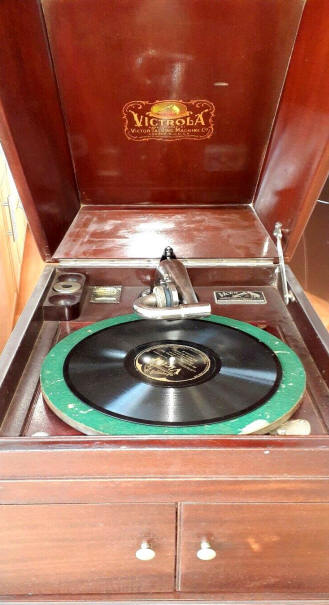 Nope, those exterior surfaces are smooth as silk, just with a slightly
different color and glossiness than the area under the lid. Therefore, this
is also an "incorrect restoration", and the machine will frankly not be worth much in today's market.
The
VV-IX (picture lower right) is an original finish, with typical aging effects on the
cabinet's exterior. You can see that the entire inside area retains
the same color and luster, and that the exterior certainly shows consistent signs of wear and aging.
It's all a matter of doing good detective work.
Nope, those exterior surfaces are smooth as silk, just with a slightly
different color and glossiness than the area under the lid. Therefore, this
is also an "incorrect restoration", and the machine will frankly not be worth much in today's market.
The
VV-IX (picture lower right) is an original finish, with typical aging effects on the
cabinet's exterior. You can see that the entire inside area retains
the same color and luster, and that the exterior certainly shows consistent signs of wear and aging.
It's all a matter of doing good detective work.
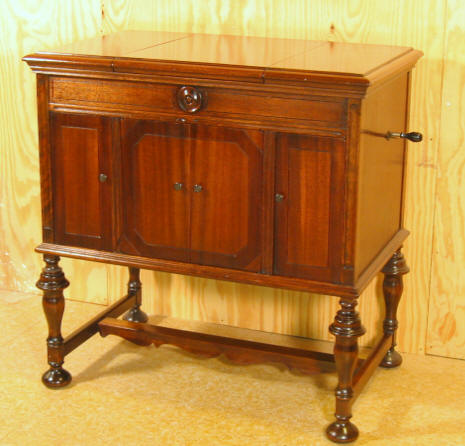 Many
readers submit pictures of phonographs which they sincerely believe to be
original, when it is obvious that a restoration was performed, possibly many
years ago. If a previous owner restored the machine back in 1960, the finish
may now appear to be old. Since that time, the phonograph may have been
stored in damp locations, or may have been knocked-around a bit; so that 60
year-old restoration may now look like an original finish. The buyer must
always look carefully for the 'tell-tale' signs of restoration which are
usually discernable. Sometimes the indicators are subtle. The machine on the
left was restored using the correct materials, but the shading is not
correct. The shade should be lighter toward the center of the middle doors,
and slowly blend to a darker color on the outside edges. Victor never
stained these models with a 'banded' stain around the doors. A sharp eye
will usually detect something wrong, but in some cases, only an expert would be able
to determine originality.
Previous owners may have used a solvent
such as naphtha to rub-down a rough original finish
and carefully smooth it out without stripping it off. This process is referred to as 're-amalgamation'. This is also a form of restoration, and depending
on how well the job was executed, it can also be classified as an
"Incorrect Restoration".
In other situations,
a machine may have undergone work where the original finish has been removed
completely (below right). This VV-90 was stripped right down to the
bare wood, and a thin coating of shellac was applied over it. This is also
considered to be a incorrect restoration because the original finish is gone
and was replaced with virtually nothing. Upon careful inspection, one can
also note that small elements of the dark original finish can still be seen
in the 'nooks and crannies' around the trim parts and doors. To be returned
to an acceptable state, this machine must be stripped again, and properly
refinished, which will be an expensive and time-consuming process.
Another
tell-tale sign of a marginal restoration is when the area around the
"Victrola" decal is darker or of a different shading than the surrounding
area (left). Someone stripped the finish,
but masked-off the area around the decal to preserve it. And they obviously
didn't match the original shade and glossiness when they applied the new
finish, and now the decal does not blend-in with the rest of
the lid. Another very common problem is that the restorer did not use a
grain-filler before applying the finish coat of varnish or lacquer. That is
easily seen on the picture at left, where the craggy and uneven surface is
obvious to all.
A 'partial restoration' is commonly performed when a portion of the cabinet
has been refinished, while leaving the rest of the machine original. This is
typically done when damage or severe fading is present; for example, when
one side of a cabinet is lighter than the rest, the phonograph likely sat
too close to a window for many years, resulting in sun-bleaching; damage to
the top of the lid may have occurred when a wet flower pot was placed on
top. A well-done partial restoration will maintain the same stain colors and
finish appearance as the rest of the cabinet. A poorly done job should be
apparent to almost everyone, and will reduce the value of the machine as is
the case with any amateur or poorly-executed restoration work.
Many
readers submit pictures of phonographs which they sincerely believe to be
original, when it is obvious that a restoration was performed, possibly many
years ago. If a previous owner restored the machine back in 1960, the finish
may now appear to be old. Since that time, the phonograph may have been
stored in damp locations, or may have been knocked-around a bit; so that 60
year-old restoration may now look like an original finish. The buyer must
always look carefully for the 'tell-tale' signs of restoration which are
usually discernable. Sometimes the indicators are subtle. The machine on the
left was restored using the correct materials, but the shading is not
correct. The shade should be lighter toward the center of the middle doors,
and slowly blend to a darker color on the outside edges. Victor never
stained these models with a 'banded' stain around the doors. A sharp eye
will usually detect something wrong, but in some cases, only an expert would be able
to determine originality.
Previous owners may have used a solvent
such as naphtha to rub-down a rough original finish
and carefully smooth it out without stripping it off. This process is referred to as 're-amalgamation'. This is also a form of restoration, and depending
on how well the job was executed, it can also be classified as an
"Incorrect Restoration".
In other situations,
a machine may have undergone work where the original finish has been removed
completely (below right). This VV-90 was stripped right down to the
bare wood, and a thin coating of shellac was applied over it. This is also
considered to be a incorrect restoration because the original finish is gone
and was replaced with virtually nothing. Upon careful inspection, one can
also note that small elements of the dark original finish can still be seen
in the 'nooks and crannies' around the trim parts and doors. To be returned
to an acceptable state, this machine must be stripped again, and properly
refinished, which will be an expensive and time-consuming process.
Another
tell-tale sign of a marginal restoration is when the area around the
"Victrola" decal is darker or of a different shading than the surrounding
area (left). Someone stripped the finish,
but masked-off the area around the decal to preserve it. And they obviously
didn't match the original shade and glossiness when they applied the new
finish, and now the decal does not blend-in with the rest of
the lid. Another very common problem is that the restorer did not use a
grain-filler before applying the finish coat of varnish or lacquer. That is
easily seen on the picture at left, where the craggy and uneven surface is
obvious to all.
A 'partial restoration' is commonly performed when a portion of the cabinet
has been refinished, while leaving the rest of the machine original. This is
typically done when damage or severe fading is present; for example, when
one side of a cabinet is lighter than the rest, the phonograph likely sat
too close to a window for many years, resulting in sun-bleaching; damage to
the top of the lid may have occurred when a wet flower pot was placed on
top. A well-done partial restoration will maintain the same stain colors and
finish appearance as the rest of the cabinet. A poorly done job should be
apparent to almost everyone, and will reduce the value of the machine as is
the case with any amateur or poorly-executed restoration work.
 There
are also many phonographs available for sale which have been
'over-restored'; for example using gold plating is used on parts that should
be nickel, where super-glossy nitro lacquer is used in place of varnish (a
very common problem), or
extra embellishments are added, etc. These examples would also be considered "incorrectly
restored". Victor machines made before 1925 used either varnish,
fuming, or shellac and wax as the finish coat. Victor machines made after 1925 used a semi-gloss lacquer
finish, and after 100 years the lacquer should show a considerable patina
and certainly a few dings and scratches, since lacquer is significantly less
durable than varnish. Brand new gold or nickel re-plating work can also appear overly flashy and reflective. After 100 years, a
patina will certainly develop on the hardware the best cared-for machines.
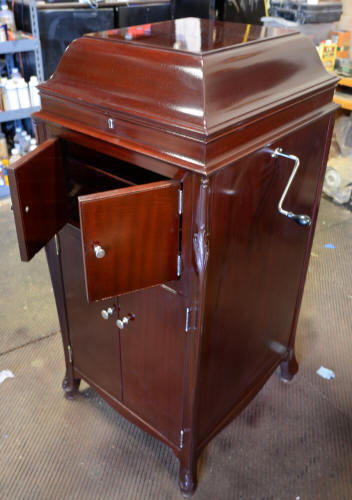
An 'over-restoration' can easily be determined if the finish appears to be
perfectly mirror-like and flawless (image at left), just like the piano
shown at the top of this page. While it looks great, this
isn't authentic, and won't bring much money to knowledgeable collectors. The
restorer most likely took the shortcut of laying down multiple coats of
modern lacquer (with light sanding in-between coats) rather than using an
authentic type of varnish. Lacquer is easy to work with...it dries quickly,
can be touched-up with little effort and has a dazzling appearance. Correct
oil-type varnish products (NOT with any modern plastic "poly" additives) is
expensive, slow to dry, picks-up dust particles, and is a pain to touch-up.
A good restorer knows how to work with it. In a worst-case but frequent
scenario, the restorer went to ACE Hardware and bought a 'handyman' polyurethane
finishing product, which will produce a plastic-like appearance and
certainly ruin any antique.
There
are also many phonographs available for sale which have been
'over-restored'; for example using gold plating is used on parts that should
be nickel, where super-glossy nitro lacquer is used in place of varnish (a
very common problem), or
extra embellishments are added, etc. These examples would also be considered "incorrectly
restored". Victor machines made before 1925 used either varnish,
fuming, or shellac and wax as the finish coat. Victor machines made after 1925 used a semi-gloss lacquer
finish, and after 100 years the lacquer should show a considerable patina
and certainly a few dings and scratches, since lacquer is significantly less
durable than varnish. Brand new gold or nickel re-plating work can also appear overly flashy and reflective. After 100 years, a
patina will certainly develop on the hardware the best cared-for machines.
An 'over-restoration' can easily be determined if the finish appears to be
perfectly mirror-like and flawless (image at left), just like the piano
shown at the top of this page. While it looks great, this
isn't authentic, and won't bring much money to knowledgeable collectors. The
restorer most likely took the shortcut of laying down multiple coats of
modern lacquer (with light sanding in-between coats) rather than using an
authentic type of varnish. Lacquer is easy to work with...it dries quickly,
can be touched-up with little effort and has a dazzling appearance. Correct
oil-type varnish products (NOT with any modern plastic "poly" additives) is
expensive, slow to dry, picks-up dust particles, and is a pain to touch-up.
A good restorer knows how to work with it. In a worst-case but frequent
scenario, the restorer went to ACE Hardware and bought a 'handyman' polyurethane
finishing product, which will produce a plastic-like appearance and
certainly ruin any antique.
Excuses are made by some restorers stating that they want to use only low VOC finishing products, which means that they don't want to spend the time and money to use the correct materials and methods. Sorry, but that is a cop-out. A good restoration service will have the necessary air-filtration systems and spray booths to protect employees and the environment, and can do the job right.
If an owner of any phonograph decides that they prefer a nice glossy lacquer or polyurethane finish, where authenticity is not a critical concern, they certainly have the right to do anything they wish with their machine. Just be aware that an incorrect restoration of any type will significantly diminish the valuation.
We have heard the snarky comment from some hobbyists "Well, nobody can ever make the machine appear as it did when it was new". That is not only an incorrect statement, but is often used as an excuse to pawn-off a mediocre restoration on an unsuspecting buyer. We have seen many outstanding restorations that essentially return the machine to 'as-new' condition without any excuses. The level of workmanship that can be attained by experienced professionals is incredible. These are time-consuming and costly endeavors, but will assure that the machine retains its value and collectability in the future.
While most collectors today avoid restoring their phonographs whenever possible, in some cases a high-quality restoration is absolutely necessary. For a rare or unusual machine that is showing signs of severe wear or damage, a restoration is often required to make the machine presentable, and this is a quite acceptable decision for most of the collector community. But that same rare machine can become severely depreciated if the restoration is not done correctly.
An incorrect restoration will usually have the following indicators:
- As mentioned above, the presence of poor color matching between the internal areas (under the lid and inside the doors) and the exterior of the machine cabinet. If the "under-lid" shades are significantly different than the exterior cabinet color, that's a possible indicator of a restoration, although it is common for exterior portions of an original cabinet to have faded over time and due to exposure to heat or dampness. Many amateur restorers will simply strip and refinish the outside of the cabinet, and leave the interior portions alone if they are in good shape. But in this instance, the colors and glossiness of the inside and outside will rarely match. If the exterior has an original finish and has faded over time, other evidence of long-term exposure (such as dings and scratches) should also be present.
- "Overcoating". It is common to find machines which have their original (faded) finish lightly 'overcoated' with shellac or other finish materials to improve the gloss and 'pop'. If the overcoat was done correctly (evenly applied, no runs or dust specs, etc.) and if polyurethane products were not used, it should have minimal impact on value in most cases. If shellac was used, the overcoat can be removed using alcohol without harming the original varnish finish.
- If you notice that the area surrounding the decal is different in color or gloss than the rest of the machine, that is an indicator of a poor restoration.
- The use of overly glossy, dull, or 'plastic-like' finish materials.
- Failure to use grain fillers on mahogany or walnut machines, resulting in a 'craggy' look (mahogany and walnut finishes). Oak will typically not have a smooth finish.
- Dust specs or blobs, especially in corners or crevices. It's somebody's basement refinish job, most likely a bad one. Those artifacts would never appear on a factory finish.
- The presence of dings, scratches or gouges which are finished-over to match the cabinet color. When the veneer on a phonograph is subjected to impacts or scratching, the resulting injury will often reveal the original (unstained) veneer color. For example, if you scratch a dark-red mahogany machine, the resulting "injury" will often appear off-white or brown due to the fact that the surface finish was removed. The application of furniture touch-up products can blend-in the correct color to some extent, but if you notice a lot of dings and zings all over the machine which have the same color as the undamaged portions of the cabinet, then you are looking at a restored phonograph. Professional restorers will use filler products to repair damage and blend-in the color prior to applying finish coats.
- Runs or drips. Victor's quality control was fantastic. We've seen a few originals with small runs from the factory that got past the Q/A inspector, but they are few and far between. If a machine has runs, splotches, or has an unevenly applied finish coat, it's a refinish job. Poor application of finish materials can also result in a slightly "wavy" appearance, as if the finish coats were not applied evenly. Check under the doors and motorboard. There will usually be some evidence of minor drips or discolorations at the bottom of doors, or inside/underneath the cabinet, even when a phonograph has been correctly restored.
- An overly perfect machine. While less than 1% of surviving examples will be classified as 'mint condition', even these rare few will show some signs of age after 100 years. This may include a patina on the hardware, as well as very minor signs of use. However, 'mint' originals certainly do exist!
- There is nothing wrong with buying a restored machine, just as long as the buyer understands that the machine is not original, and that the value will usually be less than the same machine in good original condition. Honest dealers will not hide the fact that a machine has been restored. Clueless EBay and Craigslist sellers probably won't know if the machine has been restored or not. Dishonest dealers will usually try and hide the fact that a restoration has been performed in order to secure a higher price.