Evaluating an Original Machine
If a machine is determined to have an original finish, we utilize 6 primary grading classifications. It should be noted that many appraisers will use a '+' or '-' symbol to indicate that the condition is slightly better or worse than the overall category indicates.
- ORIGINAL-MINT: This category consists of less than 1% of the surviving population. This correlates with our "CONDITION 1" category for machine sales
- ORIGINAL-EXCELLENT: This category consists of about 3% of the surviving population. This correlates with our "CONDITION 2" category for machine sales
- ORIGINAL-GOOD: This category consists of about 15% of the surviving population. This correlates with our "CONDITION 3" category for machine sales
- ORIGINAL-FAIR: This category consists of about 25% of the surviving population. This correlates with our "CONDITION 4" category for machine sales, although we rarely stock machines of this type unless they are extremely rare.
- ORIGINAL-POOR: This category consists of about 35% of the surviving population. We do not sell machines in this category.
- ORIGINAL-P/M (Parts Machine): This category consists of the remaining 20% of the surviving population. (Many phonographs which would have fallen into this category have already been junked over the years). We do not sell machines in this category
It is interesting to note that about 60% of our readers who submit information to us about their machines classify them as "Original Mint" or "Original Excellent". In reality, only about 4% of surviving machines fall into these two categories (combined). This simply indicates that most owners have a very inflated perception of their machine's true condition.
 A. ORIGINAL-MINT
Less than 1% of surviving machines. It is the extremely
rare 100+ year-old phonograph that appears in true mint condition ('as
new'). We have certainly seen some incredible mint original phonographs, and
they can be worth a lot of money. Incredible originals are certainly
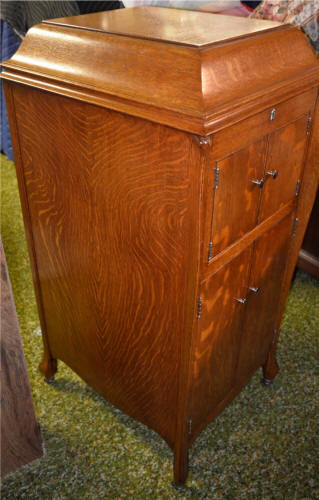
still around, such as this oak VV-XI (left) which brought very good money
for a common machine at a recent auction. It had been covered-over in
blankets inside a closet for most of its life. Flawless machines which fall
into this category are highly prized by collectors, but the buyer must
carefully inspect the cabinet and hardware to assure that it is truly an
original finish. Mint condition means exactly what it implies. A flawless original
finish and hardware, perfect plated hardware components, the original
turntable felt, and the presence of the correct license sticker. If it shows any scratches, discoloration, corrosion, wear or
dings, then it is not an ORIGINAL-MINT rated machine. It has to be at least
99% flawless. Not many are out there. When selling machines, we rate these
as "CONDITION ONE".
A. ORIGINAL-MINT
Less than 1% of surviving machines. It is the extremely
rare 100+ year-old phonograph that appears in true mint condition ('as
new'). We have certainly seen some incredible mint original phonographs, and
they can be worth a lot of money. Incredible originals are certainly
still around, such as this oak VV-XI (left) which brought very good money
for a common machine at a recent auction. It had been covered-over in
blankets inside a closet for most of its life. Flawless machines which fall
into this category are highly prized by collectors, but the buyer must
carefully inspect the cabinet and hardware to assure that it is truly an
original finish. Mint condition means exactly what it implies. A flawless original
finish and hardware, perfect plated hardware components, the original
turntable felt, and the presence of the correct license sticker. If it shows any scratches, discoloration, corrosion, wear or
dings, then it is not an ORIGINAL-MINT rated machine. It has to be at least
99% flawless. Not many are out there. When selling machines, we rate these
as "CONDITION ONE".
 ORIGINAL-EXCELLENT
About
3% of surviving machines. An "EXCELLENT" original-finish phonograph is
simply one-step below a "MINT" example. It must have very little evidence of
wear or use, and will appear to the novice as being an 'almost-new' machine.
Most sellers and inexperienced collectors are far too generous in their use of
"EXCELLENT"; it must be reserved for those few machines which have been
exceptionally cared-for and show very little variation from a brand new
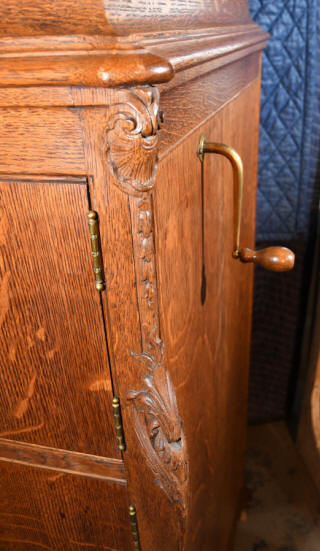
machine. The VV-XVI (picture at left) has a beautiful original waxed
oak finish and shows virtually no wear. However, there are some minor age
discoloration marks above the top doors, and a few black 'spots" as can be
seen around the trim and on the bottom doors. Even though it is a spectacular original example,
these blemishes will prevent it from being classified as "MINT". Serious
collectors pay attention to these details.
When selling machines, we rate these as "CONDITION TWO".
ORIGINAL-EXCELLENT
About
3% of surviving machines. An "EXCELLENT" original-finish phonograph is
simply one-step below a "MINT" example. It must have very little evidence of
wear or use, and will appear to the novice as being an 'almost-new' machine.
Most sellers and inexperienced collectors are far too generous in their use of
"EXCELLENT"; it must be reserved for those few machines which have been
exceptionally cared-for and show very little variation from a brand new
machine. The VV-XVI (picture at left) has a beautiful original waxed
oak finish and shows virtually no wear. However, there are some minor age
discoloration marks above the top doors, and a few black 'spots" as can be
seen around the trim and on the bottom doors. Even though it is a spectacular original example,
these blemishes will prevent it from being classified as "MINT". Serious
collectors pay attention to these details.
When selling machines, we rate these as "CONDITION TWO".
 ORIGINAL-GOOD
About
15% of surviving machines. A phonograph classified as "Original Good" is a
very presentable and complete example, showing below-average wear and
usage. While there may be minor blemishes and mild crazing (surface
roughness due to aging of the varnish), these imperfections are not
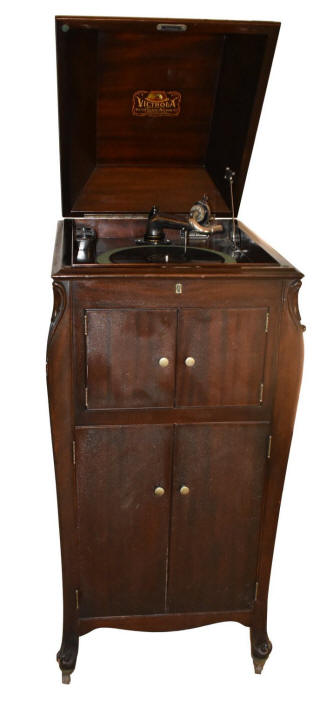
sufficient to detract from the overall appearance. The example at left shows
a complete and correct machine, with very little evidence of exterior color
fade. The nickel-plated hardware is in good shape and
still has plenty of 'sparkle'. Some crazing can be seen on the doors, but
not to the extent where it appears to overwhelm the finish (which still
retains nice depth and some of its original gloss).
When selling machines, we rate these as "CONDITION THREE".
ORIGINAL-GOOD
About
15% of surviving machines. A phonograph classified as "Original Good" is a
very presentable and complete example, showing below-average wear and
usage. While there may be minor blemishes and mild crazing (surface
roughness due to aging of the varnish), these imperfections are not
sufficient to detract from the overall appearance. The example at left shows
a complete and correct machine, with very little evidence of exterior color
fade. The nickel-plated hardware is in good shape and
still has plenty of 'sparkle'. Some crazing can be seen on the doors, but
not to the extent where it appears to overwhelm the finish (which still
retains nice depth and some of its original gloss).
When selling machines, we rate these as "CONDITION THREE".
 ORIGINAL-FAIR
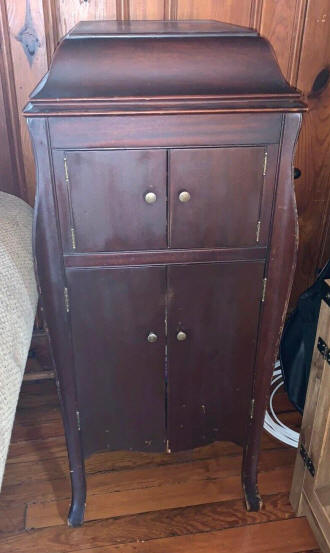
About 25% of surviving machines. A phonograph classified as "Original Fair" will
show signs of considerable wear and use, and may exhibit minor to moderate
damage. The finish will have dulled and/or faded, and the presence of
scratches and dings will be typically be found. There may be considerable
crazing (roughness) of the varnish due to long-term exposure to heat or
dampness. Interior surfaces should still retain good color and a smooth original finish. The hardware may also show moderate wear, and the original plating may have
worn-off in places. Small (non-critical) parts may be missing. Minor scratches or water rings may be present.
Phonographs in this condition are commonly found today.
When selling machines, we rate these as "CONDITION FOUR"; we only
offer machines in this category if they are extremely rare.
ORIGINAL-FAIR
About 25% of surviving machines. A phonograph classified as "Original Fair" will
show signs of considerable wear and use, and may exhibit minor to moderate
damage. The finish will have dulled and/or faded, and the presence of
scratches and dings will be typically be found. There may be considerable
crazing (roughness) of the varnish due to long-term exposure to heat or
dampness. Interior surfaces should still retain good color and a smooth original finish. The hardware may also show moderate wear, and the original plating may have
worn-off in places. Small (non-critical) parts may be missing. Minor scratches or water rings may be present.
Phonographs in this condition are commonly found today.
When selling machines, we rate these as "CONDITION FOUR"; we only
offer machines in this category if they are extremely rare.
 ORIGINAL-POOR
About
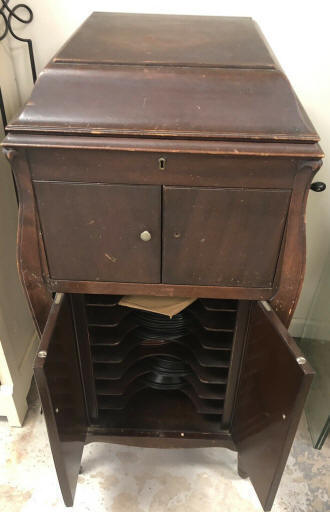
35% of surviving machines. A phonograph
classified as "Original Poor" will typically show significant damage
or wear to the
cabinet, fading and/or significant crazing of the varnish finish.
The exterior surfaces will have little or no 'shine' remaining. The
machine may be missing some important parts, and plating on the hardware may be
corroded or worn-through. Machines in this condition are also commonly found
on the auction and sale circuit today. We do not sell machines in this
category.
ORIGINAL-POOR
About
35% of surviving machines. A phonograph
classified as "Original Poor" will typically show significant damage
or wear to the
cabinet, fading and/or significant crazing of the varnish finish.
The exterior surfaces will have little or no 'shine' remaining. The
machine may be missing some important parts, and plating on the hardware may be
corroded or worn-through. Machines in this condition are also commonly found
on the auction and sale circuit today. We do not sell machines in this
category.
 ORIGINAL-P/M (PARTS MACHINE)
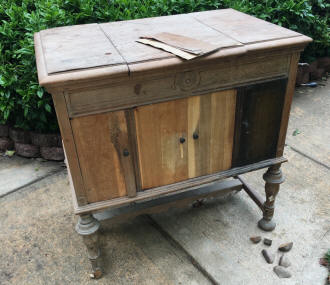
About 20% of surviving machines (since most falling in this category have
already been trashed by prior owners). A phonograph
in this classification has deteriorated
beyond practical repair or restoration, and will usually be used as a parts donor. This
may include machines which have been cut-down, are missing major cabinet
parts, or have had long-term exposure to the elements. Machines with missing
veneer (left) and/or serious water damage would also fall into this
category. Of course, a machine in POOR condition certainly can be restored,
but unless the phonograph is rare, it is usually not worth the cost of
effort. We do not sell machines in this category.
ORIGINAL-P/M (PARTS MACHINE)
About 20% of surviving machines (since most falling in this category have
already been trashed by prior owners). A phonograph
in this classification has deteriorated
beyond practical repair or restoration, and will usually be used as a parts donor. This
may include machines which have been cut-down, are missing major cabinet
parts, or have had long-term exposure to the elements. Machines with missing
veneer (left) and/or serious water damage would also fall into this
category. Of course, a machine in POOR condition certainly can be restored,
but unless the phonograph is rare, it is usually not worth the cost of
effort. We do not sell machines in this category.