VV-IV
The VV-IV or "Victrola the Fourth" was Victor's first economical internal-horn tabletop "Victrola" model. Its introduction in the spring of 1911 was concurrent with the launch of a wide lineup of newly-designed machines, which included models such as the VV-X and VV-IX. During its 13 year production run, it became Victor's #3 top-selling model of all time. This little phonograph made a Victrola affordable to buyers who, only a few years earlier, could never dream of owning a talking machine. In addition, it made for a popular Christmas gift for children whose parents had the financial means to purchase this type of product. Originally selling for just $15.00 new (which equates to $530.00 in today's money), it was a very simple and basic machine, but could produce an impressive sound quality for the era. The IV underwent several design iterations during its lifespan. A total of more than 590,000 VV-IV machines were produced between 1911 and 1924. Since there were four basic variations of the VV-IV model, they will be split into major chronological groupings. A detailed breakdown of serial number vs. year produced can be found at the bottom of the page.
Iteration One: "Metal Grille" Cabinet (1911-1912)
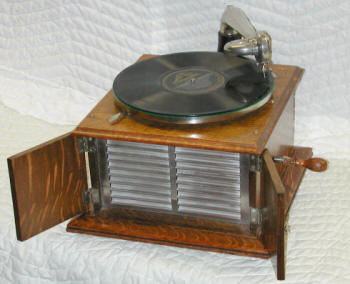 The
VV-IV phonograph was introduced during the summer of 1911, and featured a very
basic single-spring motor, nickel plated hardware and Victor's "No. 15"
soundbox, which was similar to the popular "Exhibition" version, but with a
shrouded housing which protected the fragile mica diaphragm. This indicates that
Victor may have originally intended the IV to be primarily used by younger
listeners (e.g. as a gift to children). A small, but well-made, solid oak
cabinet was used. These cabinets, as was the case for all VV-IV and VV-VI
models, were made by outside suppliers; assembly of the mechanical components
was completed at the Victor plant in Camden, NJ.
The first iteration used a stamped metal grille to cover the horn opening, which
served to hide the motor and mechanical components inside. Sound was routed
directly from the tonearm through a crude wood baffle to the horn opening.
Production of this design iteration likely ended late in the year.
While these early versions are not considered to be "rare", they do garner
slightly more collector interest than the later designs. Based on the serial numbers of
surviving examples, approximately 12,000 of these machines were made.
The
VV-IV phonograph was introduced during the summer of 1911, and featured a very
basic single-spring motor, nickel plated hardware and Victor's "No. 15"
soundbox, which was similar to the popular "Exhibition" version, but with a
shrouded housing which protected the fragile mica diaphragm. This indicates that
Victor may have originally intended the IV to be primarily used by younger
listeners (e.g. as a gift to children). A small, but well-made, solid oak
cabinet was used. These cabinets, as was the case for all VV-IV and VV-VI
models, were made by outside suppliers; assembly of the mechanical components
was completed at the Victor plant in Camden, NJ.
The first iteration used a stamped metal grille to cover the horn opening, which
served to hide the motor and mechanical components inside. Sound was routed
directly from the tonearm through a crude wood baffle to the horn opening.
Production of this design iteration likely ended late in the year.
While these early versions are not considered to be "rare", they do garner
slightly more collector interest than the later designs. Based on the serial numbers of
surviving examples, approximately 12,000 of these machines were made.
Iteration Two: Cabinet with 5 "slats" in horn opening (1912-1917)
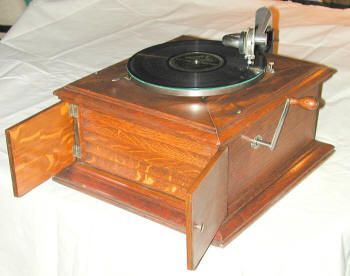 The
IV was moderately redesigned in early 1912, with a slightly smaller cabinet and
downward-facing wood slats replacing the metal grill in the horn opening. These
Victrolas will have an "A", "B", "C", "D", or "E" suffix letter after the serial
number, indicating small upgrades to the motor and/or mechanical components.
The 'flat-shank' winding key (crank) as seen at left was replaced with a
round-shank version in 1914. Approximately 315,000 copies of this variation were
produced. Due to the large volume that were originally produced, later-versions
of the VV-IV (and many similar low-cost Victrola models) are typically ignored
by collectors today, unless in exceptional original condition. They are simply
too basic in design, and far too many were produced to be considered
'collectible' in the current market.
The
IV was moderately redesigned in early 1912, with a slightly smaller cabinet and
downward-facing wood slats replacing the metal grill in the horn opening. These
Victrolas will have an "A", "B", "C", "D", or "E" suffix letter after the serial
number, indicating small upgrades to the motor and/or mechanical components.
The 'flat-shank' winding key (crank) as seen at left was replaced with a
round-shank version in 1914. Approximately 315,000 copies of this variation were
produced. Due to the large volume that were originally produced, later-versions
of the VV-IV (and many similar low-cost Victrola models) are typically ignored
by collectors today, unless in exceptional original condition. They are simply
too basic in design, and far too many were produced to be considered
'collectible' in the current market.
Iteration Three: Hollow-horn opening (1917-1918)
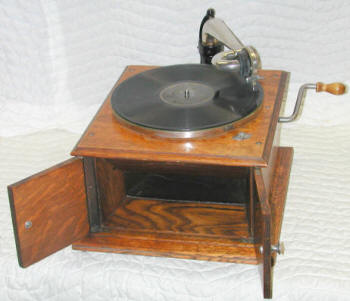 The
cabinet was modified again in 1917, and the wood slats were removed. Sound was
now directed from the tonearm through a small cast-iron horn "neck" to the horn
opening, which no longer used wood slats. These machines will have an "A"
suffix after the model number (e.g. VV-IV-A). Approximately 86,000 copies of
this variation were produced.
The
cabinet was modified again in 1917, and the wood slats were removed. Sound was
now directed from the tonearm through a small cast-iron horn "neck" to the horn
opening, which no longer used wood slats. These machines will have an "A"
suffix after the model number (e.g. VV-IV-A). Approximately 86,000 copies of
this variation were produced.
Iteration Four: Cabinet with 3 slats in horn opening (1918-1924)
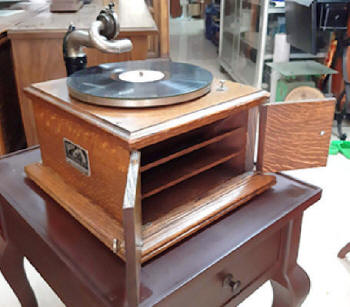 The
final version of the VV-IV was launched in 1920, now with three upward-facing
wood slats in the horn opening. Production of this design ran until the
spring of 1924. Victor ultimately produced more of these models than could be
sold at list price. Due to this overproduction, it is quite likely that
many late-production VV-IV machines were sold during Victor's well-advertised "half-price" sale
during the summer of 1925. Per Robert Baumbach's "Victor Data Book",
shipping summaries indicate that these models were still being shipped from the
factory throughout all of 1926; by that time, it is likely that many were
heading to overseas markets.
The
final version of the VV-IV was launched in 1920, now with three upward-facing
wood slats in the horn opening. Production of this design ran until the
spring of 1924. Victor ultimately produced more of these models than could be
sold at list price. Due to this overproduction, it is quite likely that
many late-production VV-IV machines were sold during Victor's well-advertised "half-price" sale
during the summer of 1925. Per Robert Baumbach's "Victor Data Book",
shipping summaries indicate that these models were still being shipped from the
factory throughout all of 1926; by that time, it is likely that many were
heading to overseas markets.
| Manufacture Date | Approximate Serial Number Range | Feature Notes |
|---|---|---|
| 1911 | 501-20000 | Stamped Steel Horn Grille ends around S/N 12000, then replaced by conventional wooden slats. Flat Crank Shank. Speed control located on rear of motorboard. Early examples use a Victor "No 15" soundbox. |
| 1912 | 20000-75000 | Some machines have an A or B suffix |
| 1913 | 75000-112000 | B suffix until replaced by C suffix very late in year |
| 1914 | 112000-163500 | C, D or E suffix used. Use of round crank shank begins around S/N 160700 |
| 1915 | 163500-215000 | E suffix |
| 1916 | 215000-290000 | E suffix. Some machines use "IV-" as model designation after mid year |
| 1917 | 290000-380000 | E suffix early in year. IV-A designation used after mid-year (around S/N 328000). Slatless ("hollow") horn opening on late year machines. |
| 1918 | 380000-434000 | Three horn slats return on machines made after mid-year (around S/N 400000) |
| 1919 | 434000-463000 | IV-A designation discontinued early in year (around S/N 440000) |
| 1920 | 463000-499000 | |
| 1921 | 499000-520000 | |
| 1922 | 520000-560000 | |
| 1923 | 560000-600000 | |
| 1924 | 600000-630000 | Note that many large blocks of serial numbers were likely skipped during production. |
The survival database currently shows the earliest existent VV-IV to be S/N 751 and the latest to be S/N 629252. Please note that several large blocks of serial numbers were likely skipped in production; therefore the total number produced and the highest serial number will not be correlated for this model!
Do you own a Victrola VV-IV? Please take a moment and enter some basic information about your machine into the collector's database by clicking here. No personal information is required.