VV-XVIII / VE-XVIII
 The
VV-XVIII or "Victrola the Eighteenth", was the short-lived 'super-premium' phonograph model in Victor's
1915-1916 product lineup. Victor had previously attempted to penetrate the
high-end phonograph market as far back as 1908 with the introduction of the
rather gaudy VV-XX models, which turned-out to be a
failure in
the marketplace. Beginning in 1909, special-finish machines such as the $400.00 gold-leaf
"Vernis Martin" models were produced in very
limited numbers. Even more costly custom-made Victrolas were available on
special order; however fulfillment of these orders would require a wait of many
months before the machine was delivered. The VV-XVIII was a renewed attempt to
add a high-end machine to Victor's standard lineup of production phonographs.
Introduced in the Spring of 1915, the XVIII could be ordered from the catalog
and displayed by any dealer who wished to show-off an example of Victor's outstanding cabinet
work. Retailing for $300.00 (which equates to almost $10,000.00 in today's
money), the XVIII was certainly not intended for the average phonograph buyer.
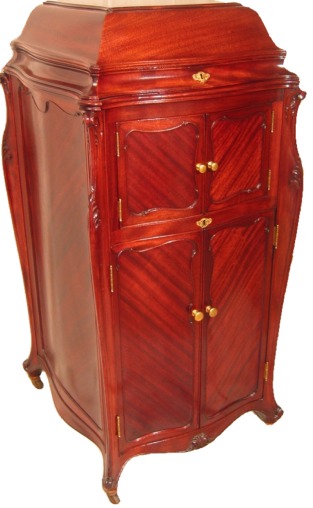
This new design was Victor's first attempt at a mass-produced bombe' style cabinet,
with convex 'swell' doors and side panels. It also featured considerable hand-carved trim on the corner posts, ornate beading on the doors,
Victor's best 3-spring motor, gold-plated hardware, and premium red or brown
stained mahogany wood veneers (left).
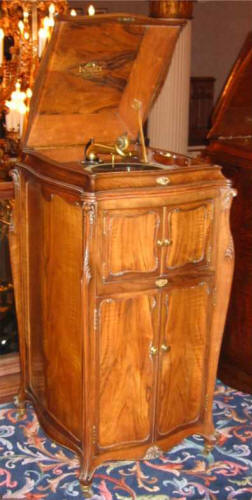
A number of appearance options were available; finishes in Circassian (right) or
American Walnut added $50.00 to the price tag; a gold Vernis Martin finish (as
was available on the VV-XVI) would double the list price; in addition, a few highly exotic
finishes were produced.
An electric motor option (designated as "VE-XVIII") was also available, adding
$50.00 to the list price.
While these beautiful machines are prized by collectors today, the XVIII was not
successful in the marketplace. Dealer orders were slow. It was quietly
discounted by $50.00 and dropped from the catalog in late 1916, and was
subsequently replaced by the
less-expensive VV-XVII.
The
VV-XVIII or "Victrola the Eighteenth", was the short-lived 'super-premium' phonograph model in Victor's
1915-1916 product lineup. Victor had previously attempted to penetrate the
high-end phonograph market as far back as 1908 with the introduction of the
rather gaudy VV-XX models, which turned-out to be a
failure in
the marketplace. Beginning in 1909, special-finish machines such as the $400.00 gold-leaf
"Vernis Martin" models were produced in very
limited numbers. Even more costly custom-made Victrolas were available on
special order; however fulfillment of these orders would require a wait of many
months before the machine was delivered. The VV-XVIII was a renewed attempt to
add a high-end machine to Victor's standard lineup of production phonographs.
Introduced in the Spring of 1915, the XVIII could be ordered from the catalog
and displayed by any dealer who wished to show-off an example of Victor's outstanding cabinet
work. Retailing for $300.00 (which equates to almost $10,000.00 in today's
money), the XVIII was certainly not intended for the average phonograph buyer.
This new design was Victor's first attempt at a mass-produced bombe' style cabinet,
with convex 'swell' doors and side panels. It also featured considerable hand-carved trim on the corner posts, ornate beading on the doors,
Victor's best 3-spring motor, gold-plated hardware, and premium red or brown
stained mahogany wood veneers (left).
A number of appearance options were available; finishes in Circassian (right) or
American Walnut added $50.00 to the price tag; a gold Vernis Martin finish (as
was available on the VV-XVI) would double the list price; in addition, a few highly exotic
finishes were produced.
An electric motor option (designated as "VE-XVIII") was also available, adding
$50.00 to the list price.
While these beautiful machines are prized by collectors today, the XVIII was not
successful in the marketplace. Dealer orders were slow. It was quietly
discounted by $50.00 and dropped from the catalog in late 1916, and was
subsequently replaced by the
less-expensive VV-XVII.
While many have surmised that the high price tag was the sole reason for the XVIII's lack of success, several factors likely contributed to its early demise, including: 1) the buying public's trend away from super-premium machines beginning in 1914, when the vast array of less expensive Victrolas (which performed and sounded identically to the high-price machines) were becoming more common in middle-class homes. Ownership of a super-expensive phonograph no longer had the same degree of 'elite appeal' as had been the case just a few years earlier; 2) the high cost of manufacture of the XVIII did not allow an adequate profit margin in low production volumes, and; 3) the XVIII cabinet was physically smaller than the 'flagship' VV-XVI model (it had the same mechanical components), yet it was priced $100.00 above the XVI. The XVIII may not have provided an adequate degree of perceived added-value over its lower-cost (yet still impressive) XVI 'cousin'. A total of just over 3,400 VV-XVIII's were produced during the spring and summer of 1915. Factory records indicate that just over 1,000 "VE" models were made, all in the second half of 1915. Serial numbers between 1220 and 1700 were apparently skipped for 'VE' versions during production. The fact that these machines were slow sellers from the start is indicated in Robert Baumbach's "Victor Data Book", which shows that the factory was still shipping unsold inventory of these models (from storage at the plant) up until the end of 1917.
The survival database currently shows the earliest existent VV-XVIII to be S/N 503 and the latest to be S/N 3888. The earliest logged VE-XVIII survivor is S/N 505 and the latest is S/N 1966.
Do you own a Victrola VV-XVIII? Please take a moment and enter some basic information about your machine into the collector's database by clicking here. No personal information is required.