Colony / VV 4-5
 The
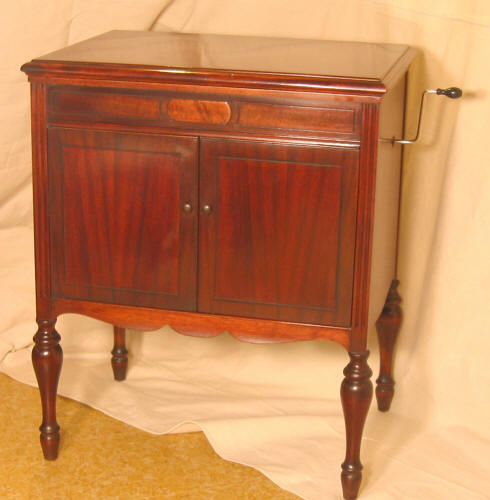
Colony (also referred to as the VV 4-5 in some of the factory
literature) was one of four premiere Orthophonic models that were introduced
in the late fall of 1925. These machines provided far better sound-quality than
any of the earlier Victrola models, with superior frequency response, higher
volume, and a far less "canned" sound quality than was experienced with the
previous generation of acoustic phonographs. For a description of the
Orthophonic machine concepts, please refer to the page
Basics of the Acoustic
Phonograph.
Two of the four introductory models, the Credenza and Consolette
had secretly been in production at the Camden plant through the late summer and
early fall months, and dealers were stocked with these two machines in time for the formal
introduction of the Orthophonic line. Interestingly, production of the Colony
(and Granada) models did not start ramping-up until October. So on the official Orthophonic launch-date of
November 2, no Colony models were available for sale at Victor dealers;
however they began appearing in time for the 1925 Christmas selling season.
The Colony was a very modest step-up from the lowest-priced Orthophonic
Consolette floor model. As was the case with the
Consolette, early-production Colony models did not have a cover over the horn
opening, and used a very basic single spring motor which must be wound after each
record is played. It also used the same small (unfolded) pseudo-exponential horn as was
used on the Consolette; so the only difference between the two models was that
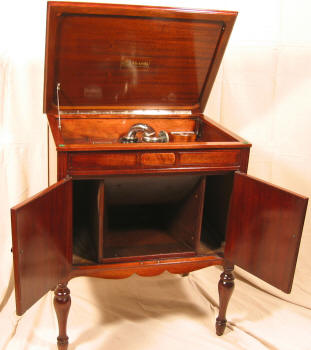
the cabinet on the Colony was 9 inches wider, allowing room to store a few
record albums on either side of the horn (picture on right). This came at an added
cost of $25.00 above the Consolette, which was quite a premium to pay for a few
inches of record storage space. Plus the large front doors, which needed to
remain open while playing records, were a bit awkward to use and required a lot of open
space on either side of the machine.
Initial sales of the Consolette models probably did not
take-off quite as strongly as expected. At the time of introduction, both these
low-cost models likely suffered from the perception of being cheaply made in
comparison to competing phonographs that were available in the same price range.
Their small, underpowered motors and the gaping open horn cavities that faced
listeners may have given buyers the perception of substandard quality, especially when compared to the
ornate cabinets and powerful motors of the previous generation of Victor
machines. So in late December 1925, a grille cloth was added to cover the horn
opening, and a vastly improved double-spring motor was added to enhance the
Colony's appearance and performance (these same improvements were also made to
the entry-level Consolette model). Sales of the Consolette then took off, but even with these aesthetic improvements, the Colony
remained a slow seller. It still provided identical acoustic performance to the Consolette, and was priced 25% higher.
The Colony was abruptly discontinued in mid-1926. It was available only in a blended-stain
mahogany finish and bright nickel-plated hardware was provided. No electric Colony models were produced.
The original 1925 selling price of the 4-5 was $110.00, which equates to about
$2,100.00 in today's money. An estimated total of 20,000 Victrola 4-5's were
produced.
The
Colony (also referred to as the VV 4-5 in some of the factory
literature) was one of four premiere Orthophonic models that were introduced
in the late fall of 1925. These machines provided far better sound-quality than
any of the earlier Victrola models, with superior frequency response, higher
volume, and a far less "canned" sound quality than was experienced with the
previous generation of acoustic phonographs. For a description of the
Orthophonic machine concepts, please refer to the page
Basics of the Acoustic
Phonograph.
Two of the four introductory models, the Credenza and Consolette
had secretly been in production at the Camden plant through the late summer and
early fall months, and dealers were stocked with these two machines in time for the formal
introduction of the Orthophonic line. Interestingly, production of the Colony
(and Granada) models did not start ramping-up until October. So on the official Orthophonic launch-date of
November 2, no Colony models were available for sale at Victor dealers;
however they began appearing in time for the 1925 Christmas selling season.
The Colony was a very modest step-up from the lowest-priced Orthophonic
Consolette floor model. As was the case with the
Consolette, early-production Colony models did not have a cover over the horn
opening, and used a very basic single spring motor which must be wound after each
record is played. It also used the same small (unfolded) pseudo-exponential horn as was
used on the Consolette; so the only difference between the two models was that
the cabinet on the Colony was 9 inches wider, allowing room to store a few
record albums on either side of the horn (picture on right). This came at an added
cost of $25.00 above the Consolette, which was quite a premium to pay for a few
inches of record storage space. Plus the large front doors, which needed to
remain open while playing records, were a bit awkward to use and required a lot of open
space on either side of the machine.
Initial sales of the Consolette models probably did not
take-off quite as strongly as expected. At the time of introduction, both these
low-cost models likely suffered from the perception of being cheaply made in
comparison to competing phonographs that were available in the same price range.
Their small, underpowered motors and the gaping open horn cavities that faced
listeners may have given buyers the perception of substandard quality, especially when compared to the
ornate cabinets and powerful motors of the previous generation of Victor
machines. So in late December 1925, a grille cloth was added to cover the horn
opening, and a vastly improved double-spring motor was added to enhance the
Colony's appearance and performance (these same improvements were also made to
the entry-level Consolette model). Sales of the Consolette then took off, but even with these aesthetic improvements, the Colony
remained a slow seller. It still provided identical acoustic performance to the Consolette, and was priced 25% higher.
The Colony was abruptly discontinued in mid-1926. It was available only in a blended-stain
mahogany finish and bright nickel-plated hardware was provided. No electric Colony models were produced.
The original 1925 selling price of the 4-5 was $110.00, which equates to about
$2,100.00 in today's money. An estimated total of 20,000 Victrola 4-5's were
produced.
For details regarding the compromised exponential horn design (used on the Consolette and Colony) during 1925's 'panic' product development program, please refer to the Consolette product page.
| Manufacture Date | Serial Number Range | Feature Notes |
|---|---|---|
| 1925 | 501-10400 | No cover over horn. Single-spring motor |
| 1926 | 10411-20492 | Cloth cover over horn. Dual spring motor |
The current survival database shows the earliest existent Colony to be S/N 535 and the latest to be S/N 20460.
Do you own a Victor Colony? Please take a moment and enter some basic information about your machine into the collector's database by clicking here. No personal information is required.